
Picture this: you’ve booked cheap flights to paradise, dreaming of perfect peeling waves. You arrive at the airport, board bag in tow, only to be slapped with an astronomical fee that costs more than your flight. Or worse, your board is refused altogether due to obscure size restrictions or a sudden baggage embargo. Even if it gets on the plane, the dread of seeing it mishandled and arriving cracked or snapped is real. Choosing an airline isn’t just about the ticket price; it’s about understanding their specific policies for sports equipment – especially bulky, fragile items like surfboards. Getting this wrong can lead to budget blowouts, major stress, and potentially a ruined trip before you even hit the water. Researching and selecting an airline with clear, reasonable surfboard policies is the first step to a successful surfari.
What Makes an Airline “Surf-Friendly” in 2025?
So, what separates a surfer’s best friend from their worst nightmare in the skies? It boils down to a few key factors:
- Clear and Accessible Policies: A surf-friendly airline makes its rules easy to find and understand on its website. Vague language or needing multiple phone calls to get a straight answer is a red flag. Look for dedicated sections on sports equipment or special baggage.
- Reasonable Fees (or None!): This is the big one. The best airlines treat surfboards (under a certain size and weight) as part of your standard checked baggage allowance. Others charge a fixed, reasonable fee ($30-$75 each way is becoming more common, though still painful). Airlines charging $100-$200+ each way, often per board rather than per bag, fall into the ‘less friendly’ category. Crucially, verify fees before booking, as they change frequently and can depend on the route, fare class, and booking time.
- Generous Size & Weight Limits: Standard baggage weight limits are often around 50 lbs (23 kg). Airlines that stick to this for surfboards (before applying hefty overweight fees) are helpful. Size limits are also critical. Many airlines use linear inches (Length + Width + Height), with common cutoffs around 115 inches. Length-specific limits vary wildly, often between 90 inches (7’6″) and 115 inches (9’6″), though some might go higher or lower, potentially depending on the aircraft type (smaller planes = stricter limits). Look for airlines accommodating typical shortboard and even mid-length sizes. Longboards (over 9 feet) often face the biggest challenges or require cargo shipping.
- Good Handling Reputation (The Intangible): While hard to quantify, some airlines develop reputations (shared through forums and word-of-mouth) for handling boards with more care. Conversely, others become notorious for damage. Remember though, baggage handling can be rough anywhere; packing well is your best defense.
- No Frequent Embargoes: Some airlines place restrictions or outright bans (embargoes) on excess baggage or specific types of sports equipment during peak travel seasons or on certain routes. Check for these!
Top Airlines for Surfboard Transport (Proceed with Caution & Verification!)
Based on recent reports and historical trends (as of April 2025), here are some airlines often cited as being relatively better for surfboard transport. WARNING: Policies and fees change constantly! This is a guide, NOT a guarantee. ALWAYS check the airline’s official website and consider calling them BEFORE booking your ticket.
- Hawaiian Airlines: Recently updated their policy to include surfboards (up to 50 lbs and 115 linear inches) as standard checked baggage, reflecting Hawaii’s surf culture. Overweight fees apply above 50 lbs. A positive move, especially for trips to the islands.
- Alaska Airlines: Often praised for reasonable sports equipment fees. Typically treats surfboards under 50 lbs and 115 inches (length) like regular baggage ($30-$35 first bag fee usually applies).
- American Airlines: Has aligned with others in treating surfboards under 50 lbs / 126 linear inches as standard checked baggage ($35-$45 fee depending on destination/fare). Overweight fees apply above 50 lbs, and a higher fee ($150) often kicks in for heavier/larger boards that are still accepted. Allows multiple boards in one bag if within limits.
- Delta Air Lines: Similar to American, often counts boards under 50 lbs and 115 linear inches as standard checked bags ($35-$45). Be mindful of Delta Connection flights, which may have stricter limits.
- Qantas: Historically very surf-friendly, often including boards within the standard baggage allowance if size/weight limits (around 32kg/70lbs, 277cm/9’0″ length) are met. Excellent choice for trips Down Under.
- Singapore Airlines: Frequently mentioned as allowing surfboards within the free baggage allowance, subject to size and weight limits.
- Emirates: Generally allows boards as part of checked baggage if total dimensions (L+W+H) are under 300cm (approx. 118 inches).
- Air New Zealand: Often allows boards under specific dimensions (e.g., < 6’5″ and < 50 lbs) for free. Larger boards may incur fees.
- Virgin Australia: Known for including surfboards within the free checked baggage allowance, making it a good option for Australian travel.
- Air Tahiti Nui: Often allows one board bag free, in addition to regular checked luggage, up to 50 lbs.
- Some Asian & European Carriers: Airlines like AirAsia, Garuda Indonesia, Aer Lingus (especially business class, or standard with fees/size limits), KLM (can be complex, check specifics), Air France (may require approval/fees), British Airways (can be free if under 190cm/6’2″ and within allowance, restrictive for larger boards), Iberia (fees apply), Lufthansa (fees apply), TAP Air Portugal (fees apply). Policies vary greatly.
Airlines to Approach with Caution (Always Double-Check!)
While any airline can transport your board if you meet their criteria and pay the fees, some are consistently cited for higher costs or stricter rules:
- Budget Airlines (General): Carriers like Spirit ($100+ each way), JetBlue ($100+ each way), Ryanair (€40-€65+ each way), EasyJet (£45-£55+ each way) often charge significant fees for surfboards, separate from standard baggage. Their business model relies on ancillary fees.
- United Airlines: Fees can be high ($150-$200 each way) and treated as special items subject to oversize/overweight charges, though they sometimes waive fees for flights to/from California. United Express flights often have much stricter size limits (e.g., 80 linear inches).
- Aeromexico: Fees often in the $75 (domestic) to $150 (international) range each way.
- Others with High Fees/Complex Rules: Check policies carefully for airlines like Avianca, Copa Airlines, LATAM, and others, as fees and rules can be substantial or complicated.
The Golden Rule: Never assume! Check the airline’s current policy on their official website before you even think about booking. If it’s unclear, call them and try to get confirmation in writing (email).
Related: Unlock Your Wave Potential: The Best All-Around Shortboards for Versatile Surfing in 2025
Tips for Flying with Your Surfboard
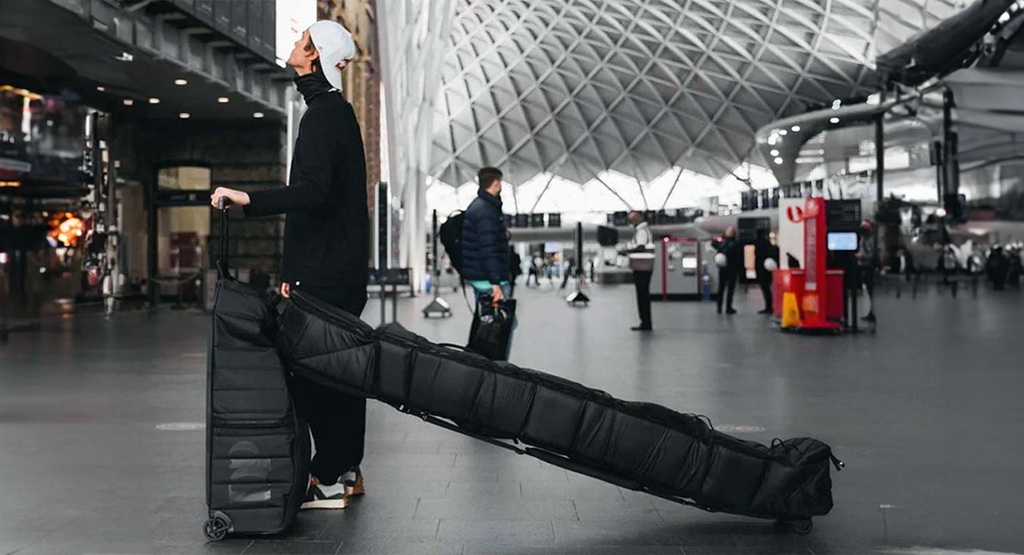
Preparation is key to protecting your board and your wallet:
- Choose the Right Bag: Invest in a high-quality, well-padded board bag. Day bags won’t cut it. For multiple boards, a ‘coffin’ style bag is best. Ensure it’s slightly longer (6 inches) than your longest board to allow for padding. Wheels can be a lifesaver in airports.
- Prep the Board:
- Remove fins (and pack them securely, perhaps wrapped in a towel, along with your fin key!). If fins are glassed-on, protect them meticulously with foam blocks, cardboard, or towels taped securely.
- Remove wax, especially if traveling to warmer climates, to avoid a sticky mess inside your bag.
- Inspect for dings before packing and repair them. Take photos as proof of pre-flight condition.
- Padding is Paramount:
- Protect the rails (edges): Use foam pipe insulation (from a hardware store, slit down one side) taped securely along the entire rail length.
- Protect nose and tail: These are high-impact zones. Use extra towels, bubble wrap, or wetsuits packed tightly around these areas.
- Deck and bottom: Use bubble wrap (large bubbles are best) or slide the board into a board sock before putting it in the main bag.
- Pack Smart:
- Place the largest board at the bottom (fins removed). Stack smaller boards on top, rockers aligned. Use towels or thin foam between boards.
- Fill empty spaces with soft items like clothes, towels, or wetsuits for extra padding and to potentially save on other luggage fees. Distribute weight evenly. Be mindful not to make the bag too heavy (check airline limits!).
- Secure everything: Use internal straps if your bag has them, or add your own (like roof rack straps) to stop boards from shifting. Tape external zippers shut for extra security.
- Logistics:
- Declare your surfboard when booking if possible, or call the airline well in advance. Some require pre-approval.
- Weigh your packed bag at home to avoid surprise overweight fees at the airport (often very expensive!).
- Arrive early: Checking in oversized items takes extra time. You’ll likely need to take it to a separate oversized baggage drop-off point.
- Consider travel insurance that specifically covers sports equipment for damage or loss. Airline liability is often limited.
- Upon Arrival:
- Collect your board from the oversized baggage area (it usually doesn’t come out on the main carousel).
- Inspect it immediately, right there at the airport. If there’s damage, report it to the airline’s baggage service desk before leaving the airport and file a claim. Take photos of the damage and keep all documentation.
Related: The Ultimate Guide to Choosing the Best Beginner Surfboard in 2025
People Also Ask (FAQs)
Q1: How much does it typically cost to fly with a surfboard in 2025?
- It varies wildly. Some airlines include it in standard baggage fees ($35-$45) if under size/weight limits (often 50 lbs/115 linear inches). Many charge specific sports equipment fees ($75-$150 each way is common). Budget airlines can be $100-$200+ each way. Always check the specific airline’s current policy before booking.
Q2: Can I bring my surfboard as carry-on luggage?
- Almost certainly no. Surfboards are far too large for carry-on restrictions on virtually all airlines. They must be checked as baggage.
Q3: What are the typical size and weight limits for surfboards on planes?
- Weight: The common threshold before overweight fees kick in is 50 lbs (23 kg). Max weight is often 70 lbs (32 kg) or sometimes 100 lbs (45 kg), beyond which it might need to be shipped as cargo.
- Size: Often limited by length (common limits range from 190cm/6’2″ to 292cm/9’6″) or linear inches (Length+Width+Height), frequently capped around 115 inches. Longboards (over 9′) are often problematic or incur higher fees/require cargo. Limits vary significantly by airline and aircraft type.
Q4: Do budget airlines take surfboards?
- Yes, most do, but usually at a significant extra cost ($100-$200+ each way is typical). These fees are a key part of their revenue model. Check their policies very carefully.
Q5: What happens if my surfboard is damaged during the flight?
- Airlines have limited liability for damage, especially if they deem it improperly packed. Inspect your board at the airport upon arrival. If damaged, immediately go to the airline’s baggage service counter, report it, fill out a damage report, and take photos. Filing a claim after leaving the airport significantly reduces your chances of compensation. Travel insurance covering sports gear is highly recommended.
Q6: Is it better to rent a surfboard at the destination?
- It depends! Renting avoids airline fees and hassle but means you might not have your preferred board shape/size, and rental quality varies. For short trips or destinations with good rental options, it can be easier. For longer trips or if you’re particular about your equipment, bringing your own might be worth the effort and cost if you choose the right airline and pack well.
Conclusion
Flying with your surfboard doesn’t have to be a wave of frustration. While airline policies can seem as shifting as the tides, armed with current information and meticulous preparation, you can significantly increase your chances of a smooth journey. Remember the mantra: Research, Verify, Pack Well. Check the specific airline’s current policies directly before booking, understand the potential costs, invest time in padding your board like it’s made of glass, and know the procedure if damage occurs. Choosing a historically surf-friendly airline can tip the odds in your favor, but never rely on old information. Do your homework, pack like a pro, and soon you’ll be paddling out at your dream destination, board intact and ready for adventure. Safe travels and epic swells!

