
So, you’ve outgrown your beloved foamie. You’ve caught enough waves to know that this “surfing thing” is no fluke. You’ve been gliding down the face of green waves, popping up with ease (well, most of the time), and now you’re ready for the next step is the best fiberglass surfboards. It’s an exhilarating stage in every surfer’s journey—a rite of passage.
But make no mistake: jumping into the world of fiberglass boards without the right knowledge can be frustrating. Choose wrong, and you might feel like you’re back at square one. Choose right, and you’ll unlock smoother turns, faster paddling, and a deeper connection with the wave.
Let’s explore everything you need to know about finding the best fiberglass surfboards for beginner surfers, and how to make that transition as smooth and stoke-filled as possible.
Best Fiberglass Surfboards for Beginner Surfers

Why Fiberglass Boards Elevate Your Surfing
Fiberglass boards mark a turning point for developing surfers. Unlike foamies, which ride on the water, fiberglass boards slice through it, offering superior speed, responsiveness, and feedback.
Here’s why the upgrade matters:
- Speed Boost: Fiberglass boards are shaped with refined contours that help you maintain and generate speed more efficiently.
- Responsiveness: You’ll notice an immediate difference in turning. Fiberglass boards react faster, allowing you to direct your board with precision.
- Connection to the Wave: The feel is undeniable. Every bump, ripple, and carve becomes more vivid—almost electric.
- Durability: With proper care, a fiberglass board lasts years. Dings can be repaired. The flex remains consistent. And they look beautiful.
That said, this isn’t a green light to ditch your foamie right away. Timing is everything.
Are You Ready to Transition?
Before investing in fiberglass, ask yourself:
- Can you consistently paddle out to the lineup?
- Are you catching unbroken, green waves on your own?
- Do you pop up swiftly and ride down the line?
- Can you ride a wave for more than just a few seconds?
- Do you control your board’s direction while riding?
- Do you understand basic surf etiquette?
If you answered “yes” to most of these, congratulations—you’re ready.
If not, give yourself more time on the soft top. No shame in that. Surfing rewards patience and practice.
Fiberglass vs. Epoxy: What’s the Real Difference for You?
While we say “fiberglass,” many beginner-friendly boards are actually epoxy boards wrapped in fiberglass cloth. Here’s the difference:
| Type | Core Material | Resin Type | Feel | Best For |
| PU/Polyester (Traditional Fiberglass) | Polyurethane | Polyester | Classic flex, better wave feel | Intermediate to advanced |
| EPS/Epoxy (Modern Fiberglass) | Expanded Polystyrene | Epoxy | Lightweight, buoyant, strong | Beginners to intermediates |
For most beginners, EPS/Epoxy is ideal. More float = easier paddling and catching waves.
Volume: The Golden Metric
Volume, measured in liters, is arguably more important than length. It directly affects:
- Paddle ease
- Stability
- Wave-catching ability
Rule of Thumb: Beginners should aim for 60–90 liters, depending on weight.
Dimensions Breakdown: Size, Width, and Thickness
- Length: Start with 7’0”–9’6”. Long enough to paddle smoothly but short enough for turning progression.
- Width: 21–23 inches keeps you stable and centered.
- Thickness:75–3.25 inches gives ample float.
Avoid boards that look “too skinny” or “too short.” Performance boards are deceptive and unforgiving.
Which Shape Fits Your Surfing?
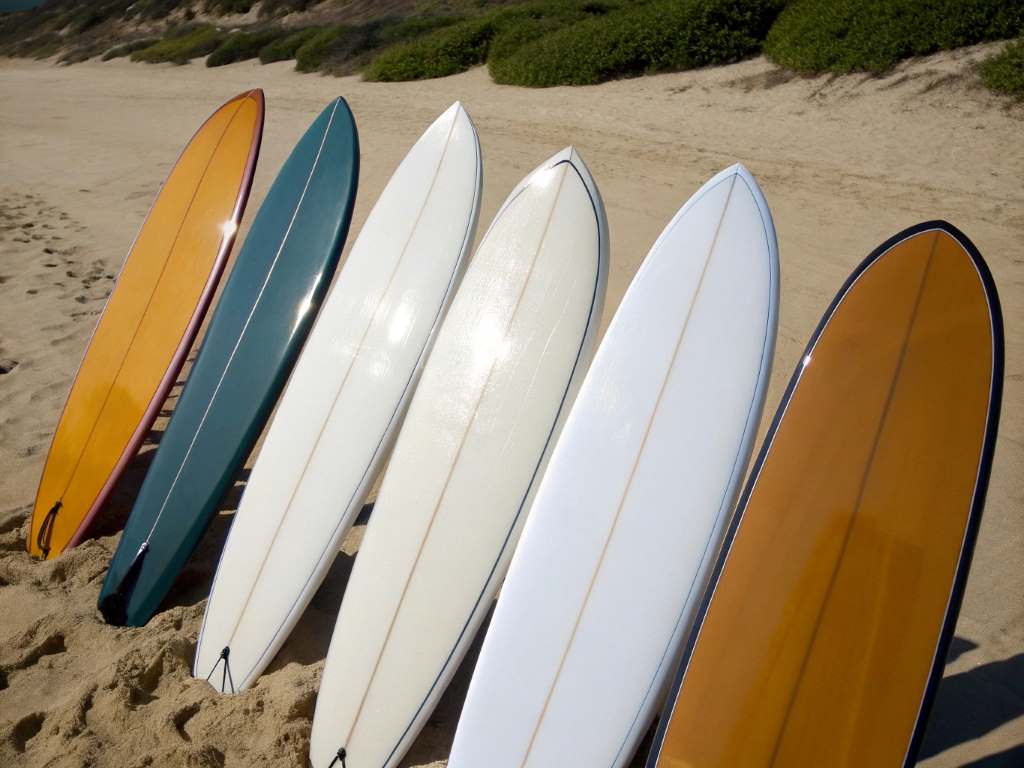
Longboards (9’0”–9’6” and up)
- Great for small, mushy waves
- Wide and stable—perfect for cross-stepping and trimming
- Excellent paddle power
- 70+ liters of volume
Mini-Mals or Funboards (7’0”–8’6”)
- More agile than longboards
- Great for experimenting with turns
- Easy to carry and store
- 50–70 liters of volume
Hybrids (6’6”–7’6”)
- A blend of funboard ease and shortboard agility
- Higher volume packed into a shorter outline
- Ideal for advanced beginners looking for progression
Avoid These Shapes as a Beginner
- Narrow shortboards (less than 19” width)
- Thin rails and pin tails
- Low-volume fish or grovelers
- Pointy noses designed for steep drops
These require wave timing, pop-up speed, and turning skills that most beginners haven’t developed yet.
Tail Shapes: Stick to Stable Designs
- Rounded Square Tail: Combines lift with hold—great for all-around control.
- Squash Tail: Offers a bit more release and turning potential while staying forgiving.
Avoid swallowtails or pintails early on—they’re made for specific conditions or advanced surfing.
Rail Shapes: Round is Right
- Full Rails: Provide more buoyancy and reduce the risk of catching an edge.
- Sharp Rails: Designed for slicing the wave—but brutal if you aren’t precise.
Fin Setups: Keep it Simple
- Thruster (3-fin): The industry standard. Balanced for control and maneuverability.
- 2+1 (longboards): Single center fin with two side bites. Offers drive and hold.
- Avoid Quad or Twin fins initially—they offer speed but less control.
Top 7 Fiberglass Surfboards for Beginner Surfers

1. Torq Mod Fun (Epoxy)
- 7’6″ length, 52 liters
- Durable, lightweight, easy to maneuver
2. NSP Elements Funboard
- Epoxy/EPS construction
- High float, great stability
3. Creative Army Huevo
- Mid-length hybrid
- Blends retro styling with progression performance
4. Modern Love Child
- Great for relaxed, cruisey surfing
- Available in 6’8” to 8’4” options
5. Softech Roller (Hard-Top Hybrid)
- Soft deck, hard bottom
- Great entry into harder boards
6. South Bay Board Co. Verve
- High volume epoxy board
- Fun, lively, yet stable
7. Firewire Surfboards Mo Fish (Epoxy)
- More for the athletic beginner
- Responsive and super fun in small waves
Transitioning from Foam to Fiberglass: Tips That Work
- Expect a Learning Curve: Your balance, pop-up, and paddling will need slight adjustments.
- Start on Small Waves: Waist-high, mellow peelers are your new training ground.
- Be Mindful of Placement: Fiberglass boards require better positioning for paddling and takeoff.
- Takeoff Angle: Begin paddling slightly angled to practice trimming down the line.
Taking Care of Your First Fiberglass Board
- Board Bag is a Must: UV rays are brutal.
- Rinse After Use: Salt corrodes and can weaken glass over time.
- Ding Check: Inspect after every session. Water inside is your enemy.
- Repair Promptly: Don’t ignore small cracks or pressure dings.
Mistakes to Avoid
- Buying a board too small too early
- Ignoring volume
- Riding performance shapes too soon
- Leaving dings unrepaired
- Surfing conditions beyond your level
Buying Tips: New vs. Used
| New Board | Used Board |
| Comes clean and ding-free | Might be cheaper |
| Higher price tag | Must check for water damage |
| Warranty often included | Great for testing shapes |
FAQs
What’s the best size fiberglass board for a beginner?
Aim for 7’6”–8’6” funboards with 50–70 liters of volume depending on your weight.
Can I go straight from a soft-top to a shortboard?
You can—but you probably shouldn’t. It’s better to master turns on a mini-mal or hybrid first.
Are epoxy boards better than fiberglass for beginners?
Generally yes. They’re lighter, more buoyant, and durable.
How do I know if a board has enough volume?
Use online volume calculators based on your weight and skill level. Always choose more volume when in doubt.
Should I wax a fiberglass board?
Yes! Unlike foamies, fiberglass boards need proper surf wax for grip.
Can I use a fiberglass board in small waves?
Absolutely! In fact, it’s best to start in small, slow waves when learning a new board.
Conclusion
Making the move from foam to fiberglass is a bold and transformative step. With the right board—balanced in volume, stability, and responsiveness—you’ll not only surf better, but feel better. Every ride becomes more expressive. Every wave more interactive.
Remember, surfing is not about rushing progression. It’s about staying stoked, staying safe, and staying in love with the journey.
So paddle out with confidence—your new fiberglass board is waiting.

