
The image is iconic: a surfer gliding effortlessly across a turquoise wave, sun glinting off the water. It’s a dream that pulls many towards the ocean, eager to experience that unique thrill. But before you can ride that wave, you need the right partner – your surfboard. For beginners, choosing that first board is arguably one of the most crucial steps in the entire learning process. Pick the right one, and you set yourself up for faster progression, more fun, and less frustration. Pick the wrong one (like that super cool, pointy shortboard your pro friend rides), and you might find yourself spending more time flailing than floating.
This guide is here to demystify the process. We’ll break down exactly what makes a great beginner surfboard in 2025, explore the different types available, and help you find the perfect board to kickstart your surfing journey with confidence and stoke.
Why Your First Surfboard Matters More Than You Think
Imagine trying to learn to ride a bicycle on a high-performance racing bike with skinny tires and an aggressive riding position. It would be wobbly, intimidating, and likely end in a few scrapes. Learning to surf on the wrong board is a similar experience. Beginner surfboards are specifically designed to counteract the initial challenges of surfing.
Details of Beginner Board Importance
The key benefits lie in stability and buoyancy. Beginner boards are typically longer, wider, and thicker than boards designed for experienced surfers. This translates to a more stable platform, making it much easier to balance while paddling and attempting to stand up (the “pop-up”). High buoyancy (thanks to ample volume) means the board floats well, supporting your weight and making paddling less strenuous. You won’t sink the board easily, and it will catch waves with less effort. This combination is crucial for building confidence. Catching waves frequently and getting those first successful rides, however short, provides the positive reinforcement needed to keep going. Trying to learn on a board that’s too small, too narrow, or lacks volume often leads to endless frustration, making it difficult to paddle, impossible to balance, and slow down your progress significantly. Starting right accelerates the learning curve and maximizes enjoyment.
Decoding Surfboard Specs: What Beginners Need to Know
Walking into a surf shop or Browse online can feel overwhelming with terms like “volume,” “rocker,” and various dimensions thrown around. For beginners, focusing on a few key features simplifies the choice immensely.
Details on Key Features
- Volume: This is perhaps the most important factor for a beginner. Measured in liters (L), volume represents the total amount of space the board occupies. More volume equals more buoyancy and more stability. Think of it as the board’s flotation power. For beginners, more volume is almost always better. It makes paddling easier because the board sits higher in the water, and it provides a more forgiving platform when you try to stand up. A common guideline is to aim for a volume in liters that is at least 75% of your body weight in kilograms, though many recommend even higher volumes for absolute beginners (some charts suggest specific volume ranges based on weight, e.g., 50-70kg might aim for 42-57L, 70-90kg for 54-82L). Don’t be afraid to go big!
- Length & Width: Generally, longer and wider boards are more stable. For beginners, lengths typically range from around 7 feet 6 inches (7’6″) up to 9 feet (9’0″) or even longer for longboards. A good rule of thumb is to choose a board that’s about 3 feet taller than you. Width adds side-to-side stability, making balancing easier. Look for boards with a generous width, often 21-23 inches or more. A wider, rounded nose shape (rather than a pointy one) also helps with stability and paddling.
- Material: This boils down to the main debate for beginners: Soft-Top vs. Hard-Top. Let’s dive into that next.
Soft-Top vs. Hard-Top: The Great Beginner Debate
The surface material of your board significantly impacts safety, durability, performance, and price – all critical considerations for learners.
Details on Board Materials
- Soft-Tops (Foamies): As the name suggests, these boards have a soft, foam deck (like dense EVA) covering a foam core (often EPS). They are the undisputed champion for beginners and surf schools, and for good reason. Their biggest advantage is safety. Falling onto foam is much more forgiving than hitting a hard surface, reducing the risk of injury to yourself and others nearby – and beginners fall a lot. They are also incredibly durable, able to withstand the inevitable bumps, scrapes, and collisions that happen while learning. Soft-tops boast excellent buoyancy and stability due to their construction and typically generous dimensions. They are generally the most affordable option, making them accessible entry points. The downside? They lack the performance and responsiveness of hard-tops, can feel heavier, and aren’t ideal for advanced maneuvers. But for mastering the basics – paddling, catching waves, popping up – they are perfect.
- Hard-Tops (Epoxy/PU): These boards have a rigid exterior, traditionally fiberglass cloth layered with Polyester (PU) or Epoxy resin over a foam core (PU or EPS, with EPS being lighter and more common now). Hard-tops offer superior performance, speed, and maneuverability. They provide a more direct connection to the wave, allowing for quicker turns and advanced techniques. However, they are far less durable than soft-tops and are easily dinged or damaged, requiring careful handling and potentially costly repairs. They are less safe due to the hard surface and are generally less buoyant and stable than similarly sized soft-tops, making paddling and balancing harder for novices. They also come with a higher price tag. While some durable epoxy constructions exist (like NSP’s EVO-Tech, designed as a bridge), traditional hard-tops are generally not recommended for your very first board.
Related: Riding the Perfect Wave: Top Australian Surfboard Brands Every Surfer Should Know
Top Surfboard Types for New Surfers in 2025
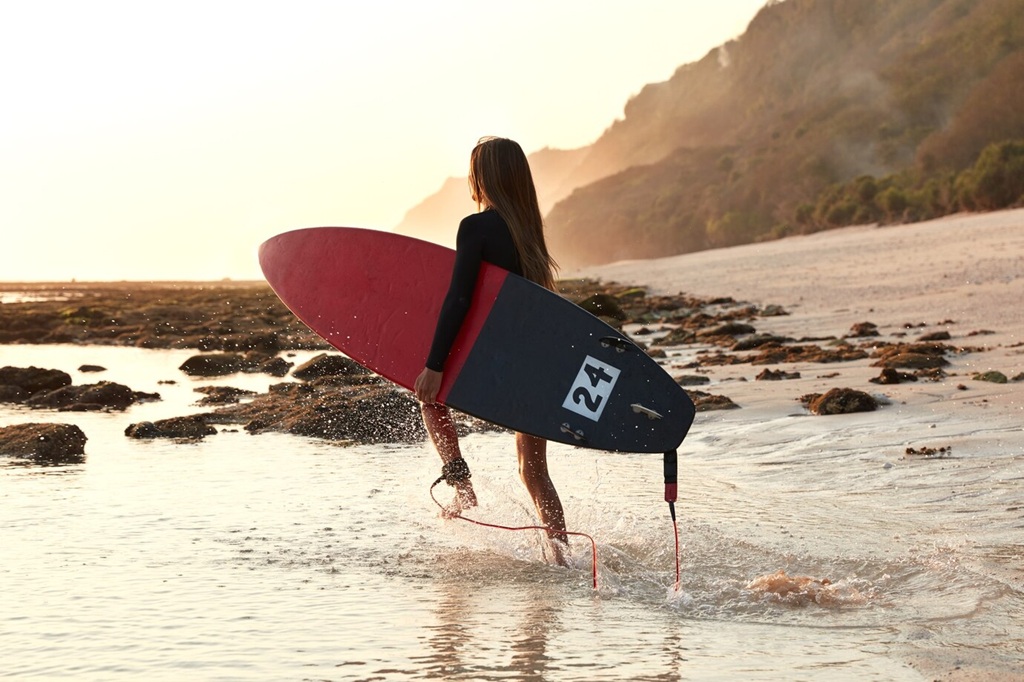
Knowing the key features helps narrow down the options. Most beginner-friendly boards fall into these categories:
Details on Board Types
- Soft-Top / Foam Surfboards: This isn’t just a material, it’s often the defining category for beginners. Most beginner-focused longboards and funboards now come in soft-top versions. They embody all the crucial elements: high volume, ample stability, safety, durability, and affordability. They are perfect for learning in small, gentle waves. Popular and highly-rated models for 2025 include the ubiquitous Wavestorm 8ft Classic (often found at Costco, known for value), the Catch Surf Odysea Log (stylish and functional), South Bay Board Co. Verve or Guppy models, the budget-friendly Decathlon Olaian 100 series, Softech Roller, and the Wave Bandit Easy Rider. You really can’t go wrong starting with a quality foamie in the 8ft+ range.
- Longboards (Foam or Hard): The classic wave-riding vehicle. True longboards are typically 9 feet or longer (though beginner models often start around 8’6″), wide, thick, and feature a rounded nose. Their sheer size offers unmatched stability and makes paddling and catching even the smallest, weakest waves incredibly easy. They provide long, smooth rides, perfect for getting the fundamentals down. The drawbacks include being cumbersome to carry and transport, difficult to turn quickly, and impossible to “duck dive” under oncoming waves (requiring the “turtle roll” technique). While foam longboards are ideal first boards, durable hard-top longboards like the NSP Elements, NSP P2 Basic, or Modern Surfboards Retro PU can be great choices once basics are mastered, or for heavier beginners needing maximum float.
- Mini-Mals / Funboards (Foam or Hard): These boards bridge the gap between longboards and shorter boards, typically ranging from 6’6″ to about 8’5″. They retain significant volume and width for good stability and easy paddling but are shorter and slightly more tapered than longboards, offering a bit more maneuverability. They are a fantastic option for lighter beginners, those progressing from a larger soft-top, or those who want a board that’s easier to handle and turn sooner. They are versatile and work well in various conditions. Popular choices include the Torq Mod Fun Mini Mal, NSP Funboard (available in Elements or softer EVO-Tech), and again, models like the Softech Roller often fit this category. They represent a compromise: less stable than a longboard, but easier to manage and turn; more stable than a shortboard, but less performance-oriented.
Related: How Much Does a Surfboard Weigh? Understanding Surfboard Weight and Its Impact
People Also Ask (FAQs)
Navigating the world of surfboards sparks many questions. Here are some common ones from beginners:
-
What size surfboard should a beginner get?
It depends heavily on your height and weight, but generally bigger is better initially. Aim for a soft-top or longboard between 7’6″ and 9’0″. A board about 3 feet taller than you is a good starting point. Prioritize high volume for stability and easy paddling – check manufacturer weight/volume charts if available.
-
Are foam surfboards (soft-tops) good for beginners?
Absolutely, yes! They are the top recommendation for most beginners due to their unparalleled combination of safety, stability, buoyancy, durability, and affordability. They make the learning process much smoother and less intimidating.
-
What’s the easiest type of surfboard to learn on?
A large soft-top longboard (8’0″ to 9’0″) generally offers the maximum stability and ease of paddling/wave catching, making it arguably the easiest platform to learn the absolute basics on. A large soft-top funboard (around 7’6″ to 8’0″) is a close second.
-
Should I start with a longboard or a funboard?
If maximum stability and catching the smallest waves easily are your top priorities, start with a longboard (especially a soft-top). If you’re a bit lighter, or want something slightly easier to carry and turn sooner (while still being stable), a funboard (mini-mal) is an excellent choice. Both are vastly better starting points than a shortboard.
-
How do I choose the right volume?
Volume is key for buoyancy and stability. Consult manufacturer size charts that recommend volumes based on weight and skill level. If charts aren’t available, use rules of thumb like ensuring the volume (in liters) is at least 75%-100% of your body weight (in kilograms). When in doubt, err on the side of more volume.
-
When should I move to a shorter/hard-top board?
Don’t rush it! Focus on mastering the fundamentals first. You’re likely ready to consider progressing when you can consistently: paddle efficiently, catch waves on your own, pop up smoothly to your feet nearly every time, and confidently ride down the line (across the wave face) while maintaining control. Taking lessons can help you gauge your progress.
Caring for Your First Board
Even durable beginner boards benefit from some basic care. Always rinse your board with fresh water after surfing to remove salt and sand. Try to store it out of direct, prolonged sunlight, which can damage materials over time (especially foam). Avoid dragging it on rough surfaces. While soft-tops are resilient, check for any cuts or punctures occasionally; small dings can often be easily repaired with the right sealant (check manufacturer advice). Keeping your gear in good shape ensures it performs well for longer.
Conclusion: Catch Your First Wave with Confidence
Choosing your first surfboard is an exciting step into the incredible world of surfing. While the options might seem endless, focusing on the core principles for beginners – ample volume, generous length and width for stability, and the safety and forgiveness of a soft-top construction – will steer you right. Whether you opt for a stable longboard or a slightly more maneuverable funboard/mini-mal, prioritize a board that makes paddling easy and catching waves achievable. Don’t be tempted by aesthetics or what the pros ride just yet.
The best beginner surfboard is the one that gets you in the water often, helps you catch waves consistently, and keeps you safe and smiling. Consider renting a few different sizes or taking a lesson (highly recommended!) to get a feel for what works best for you. Embrace the learning process, be patient with yourself, and enjoy the journey. Your perfect first wave is waiting!

